VISION:
- To produce technically competent, socially, ethically and
morally responsible technocrats and entrepreneur.
MISSION:
- To provide latest technical knowledge in field of Electrical
Engineering with special emphasis on practical aspects.
- To imbibe Social, Ethical values & behavioral etiquettes in
the students through soft skill activities, Seminar & Group
Discussion etc.
- To guide the students regarding various schemes and
entrepreneurial opportunity through various projects &
industrial visits.
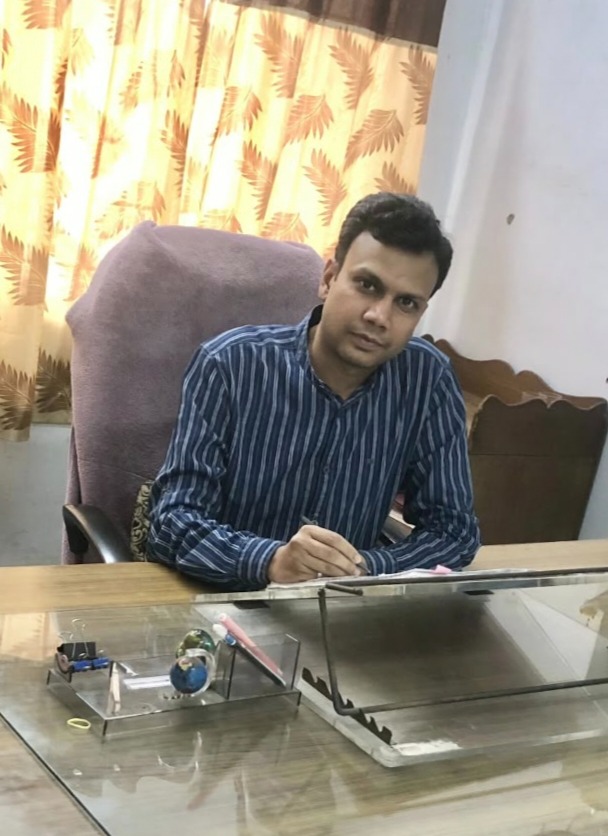
Sh. Nitin Garg
O/I, Electrical Engineering Department
Vaish Technical Institute, Rohtak, is a renowned institution that offers high-
quality education in various fields of engineering. The Electrical Engineering
Department is one of the oldest and most esteemed departments of the
institute. With a strong focus on theoretical foundations and practical
applications, the department aims to produce skilled and knowledgeable
electrical engineers who can excel in their chosen careers.
Faculty Details (Electrical Engg. Deptt.)
Staff in Electrical Engineering Department, Rohtak is highly qualified and well
experienced. All the staff members are fully dedicated and co-operative.
|
Sr. No.
|
Name of Faculty |
Designation |
| 1 |
Sh. Nitin Garg |
O/I, Electrical Engg. Deptt. |
| 2 |
Sh. Hemant Sindhu |
Guest Faculty |
| 3 |
Sh. Gaurav Kumar |
Guest Faculty |
| 4 |
Smt. Sujata Jain |
Visiting Faculty |
| 5 |
Sh. Rahul Singla |
Visiting Faculty |
| 6 |
Sh. Dheeraj |
Visiting Faculty |
| 7 |
Sh. Atul Goel |
Lab Instructor |
| 8 |
Sh. Rohit |
Guest Instructor |
Laboratories Details (Electrical Engg. Deptt.)
Basics of Electronics (BE) Lab
The Basics of Electronics Laboratory provides students with foundational
exposure to analog and digital electronic circuits, bridging theoretical
classroom concepts with practical component-level design. The facility is
equipped with regulated DC power supplies, cathode-ray and digital storage
oscilloscopes (CRO/DSO), function generators, analog/digital multimeters,
and specialized circuit training kits. Students gain hands-on proficiency in
studying the V-I characteristics of semiconductor diodes, Zener diodes,
Bipolar Junction Transistors (BJTs), and Field-Effect Transistors (FETs).
Additionally, the curriculum covers rectifier circuits, filter networks,
operational amplifiers, and fundamental digital logic gates. By testing,
breadboarding, and troubleshooting basic circuits, learners develop the
essential hardware-handling skills required for higher-semester coursework
in analog design, digital systems, and power electronics.
Electrical Machines Lab
The Electrical Machines laboratory houses an extensive range of AC and DC
machinery, including DC shunt, series, and compound motors/generators,
synchronous machines, and squirrel-cage as well as slip-ring induction
motors. Each test bench is outfitted with dedicated motor-generator sets,
resistive and inductive loading rheostats, tachometers, and safety
switchgear. Students conduct standard performance tests, including open-
circuit and short-circuit tests, load tests, efficiency determination, speed
control methods, and synchronization of alternators. The practical exposure
cultivates vital competence in machine operation, industrial wiring
standards, torque-speed analysis, and heavy-equipment safety measures.
Electrical Measurements and Measuring Instruments (EMMI) Lab
The Electrical Measurements and Measuring Instruments Laboratory focuses
on imparting rigorous skills in calibration, sensing principles, precision
measurements, and error analysis. The lab is furnished with classical
deflection instruments, digital meters, KCL, KVL, Wheatstone and Kelvin
bridges for resistance measurement, It also features transducer training
systems covering LVDTs, strain gauges, thermocouples, RTDs, and
photoelectric sensors. Students gain hands-on practice in calibrating single-
phase and three-phase energy meters, extending instrument ranges using
shunts and multipliers, and utilizing instrument transformers (CTs and PTs).
This training establishes the foundation required for modern industrial
automation, process control, and instrumentation engineering.
Computer Lab (Electrical Engg. Deptt.)
The Departmental Computer Laboratory serves as an advanced
computational and simulation hub dedicated to electrical design, numerical
analysis, and project work. The facility is equipped with networked
workstations, uninterrupted power backup, and modern computing
infrastructure running industry-standard software packages such as
AUTOCAD Electrical, MATLAB/Simulink, circuit simulation platforms, and
programming environments. Students utilize this facility for modelling power
systems, analyzing complex electrical networks, simulating machine
dynamics, and designing control systems prior to physical implementation.
The lab also supports academic instruction in computer programming,
numerical problem-solving, and computer-aided drafting (CAD) for electrical
layouts. It fosters a blended learning approach that prepares students to
meet modern computational demands in core engineering and research
sectors.
Electrical Workshop
The Electrical Workshop serves as a vital hands-on training centre focused on
foundational electrical practices, domestic and industrial wiring installations,
and essential safety protocols. The facility is equipped with dedicated wiring
booths, standard electrical toolkits, testing boards, soldering and
desoldering stations, and protective switchgear setups.
Students receive comprehensive practical instruction in:
- Executing various indoor installation methods, including batten,
conduit, staircase, and godown wiring schemes.
- Mounting and configuring distribution boards, circuit breakers (MCBs,
MCCBs, ELCBs), and energy meters.
- Assembling, testing, and fault-finding in common household electrical
appliances.
-
Implementing proper pipe and plate earthing techniques alongside
insulation resistance testing using megohmmeters (Meggers).
By adhering strictly to Indian Electricity (IE) Rules and occupational safety
standards, this workshop equips students with critical troubleshooting,
wiring estimation, and maintenance skills essential for field engineering and
technical roles.